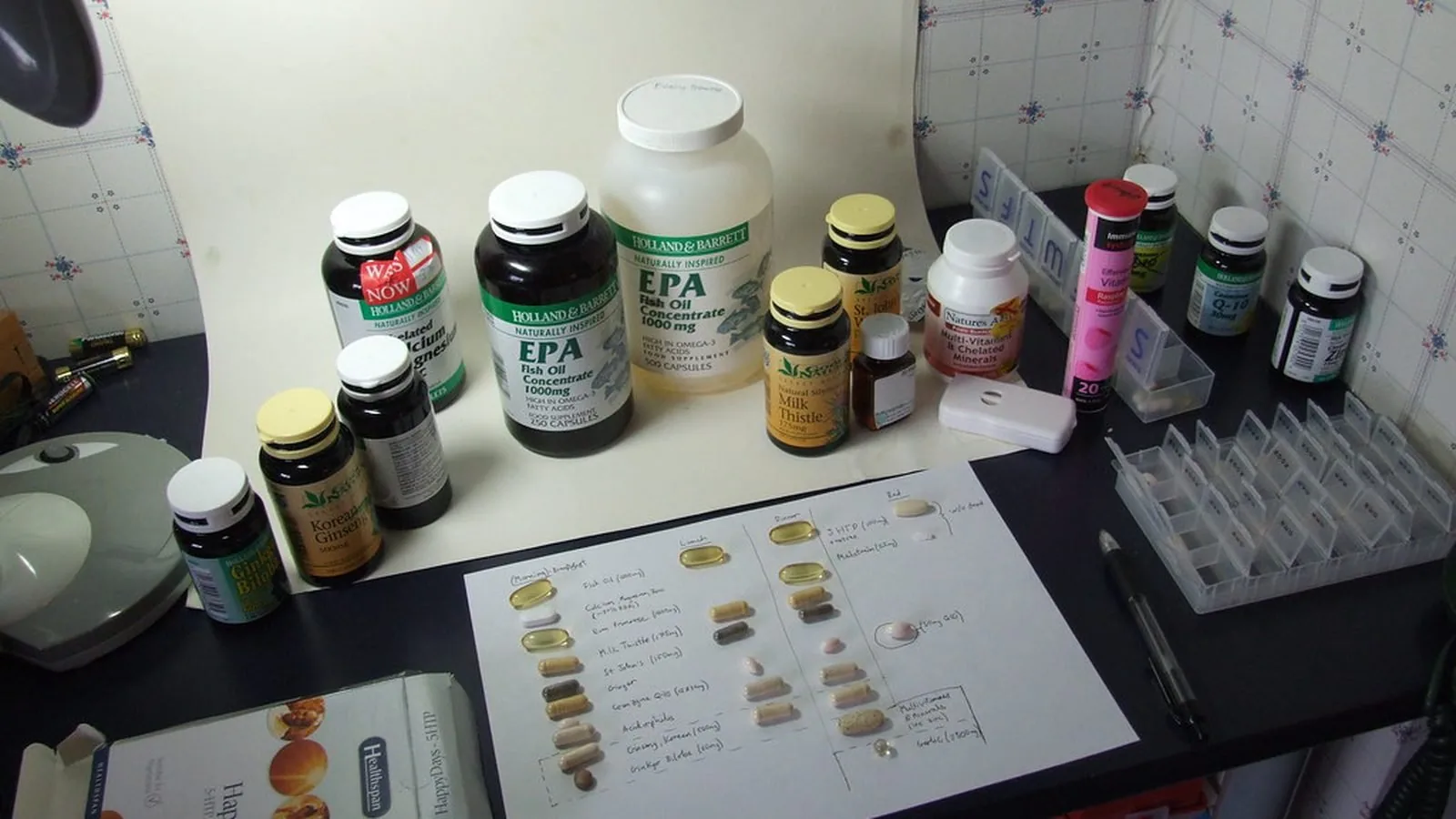
No supplement has been shown to reduce tinnitus. The 2024 VA/DoD guidelines recommend against them, and the Cochrane reviews of the two most-studied ingredients found effects too small to matter. What the evidence does not say is that they harm you, or that nobody improves. Those are different claims, and the difference is where an honest decision lives.
I have taken supplements for this. That is probably not how you expected a page like this to open.
I want to be straightforward about where I stand before I show you the evidence, because the usual version of this article is written by someone with a link at the bottom who never tells you they already decided.
So: the evidence is bad, I have read it carefully, and I still understand why people test one. What follows is what I know, in the order I would want it.
What do the guidelines say about tinnitus supplements?
The 2024 VA/DoD Clinical Practice Guideline for tinnitus recommends against dietary supplements, herbal preparations, and nutraceuticals. Ginkgo biloba is named specifically.
That is the current formal position in the United States, and this site says it on every page where a product appears, including this one.
Do ginkgo and zinc help tinnitus?
Ginkgo biloba. A 2022 Cochrane review pooled 12 randomized controlled trials covering 1,915 people. The conclusion was that ginkgo “may have little to no effect,” at very low certainty. The measured difference was 1.35 points on a 100-point tinnitus scale, and even that was not statistically reliable.
That is the best-studied ingredient in the category, measured more carefully than any of the others.
Zinc. A 2016 Cochrane review rated the evidence very low quality throughout. A 2013 randomized, double-blind, placebo-controlled trial in 116 older adults found 5% improved on zinc against 2% on placebo, a difference that did not reach significance.
Why do supplements work for some people and not others?
Read enough of this literature and something consistent appears: supplements tend to work when they correct a deficiency, and not otherwise.
B12 helps people who are low on B12. Zinc helps people who are low on zinc. Give either to someone with normal levels and the effect disappears into the noise.
That is not a small footnote. It reframes the whole question. The useful version is not “does this work on tinnitus,” it is “is my system short of something this supplies.” Which is also why results in this category vary so much between people: two people taking the same bottle are not starting from the same place.
Why do people try one anyway?
The honest situation is that the recommended options are CBT and sound therapy, both rated “Weak For,” both aimed at how much of your attention the sound takes rather than at the sound. Both require access, time, and often money. Waitlists are real.
Meanwhile you have a noise in your head every night.
Deciding to test something with weak evidence, at low cost, under a guarantee, while you wait for the things with better evidence, is not irrational. It is a reasonable response to a field that has little to offer. It stops being reasonable when the thing costs a lot, auto-renews, or is bought on the strength of a promise that cannot be true.
How do I judge a tinnitus supplement?
This is the checklist I apply, and it is the same one published in how we review products.
- Are the doses disclosed? A “proprietary blend” tells you the total milligrams and hides the split. You cannot compare it to any study, because you do not know what is in it.
- Is it a one-time purchase? Auto-renewing subscriptions are where most of the damage in this category happens, and the charge usually arrives after you stopped paying attention.
- What are the refund terms, exactly? Window, conditions, who pays return shipping, and whether opened bottles count.
- Does the marketing claim a cure? If yes, stop. It tells you what the company thinks it can say to you, which tells you what else it will say.
- Does the company stand behind it? A real refund window, clearly written, is the part of any offer that costs the seller something. It is the closest thing to a guarantee of good faith you will find in this category.
Which supplement would I look at, and why?
If I were testing something in this category today, the one I would look at is AudiQuiet, for three reasons that have nothing to do with what it promises.
It is a one-time purchase. No subscription, no auto-billing, stated plainly in their own FAQ. In a category where recurring charges are the most common complaint, that is not a small thing.
The guarantee is 60 days, and you do not return the bottles. Refund by email, no return shipping, no questions asked. This is the part that actually changes your risk: you are deciding whether to spend sixty days finding out, not whether to spend the money.
Its own FAQ declines to claim a cure. Asked directly whether it can cure hearing, the answer is that it is a dietary supplement and is not intended to diagnose, treat, cure, or prevent anything. A company willing to write that sentence where it is selling to you is telling you something about how it operates.
Two things to know before you decide, because this site says them on every product page: the label is a 200 mg proprietary blend, so individual doses are not listed, which is standard across this entire category and still worth knowing. And it is a supplement for tinnitus, which the guidelines recommend against, for the reasons laid out above.
Which package makes sense: one bottle or three?
The dose is 1 mL twice daily. The seller lists the three-bottle option as a 90-day supply and the six-bottle option as 180 days, so roughly a month per bottle. The guarantee runs 60 days from purchase.
Line those two numbers up and the format decides itself. A single bottle gives you thirty days of use inside a sixty-day refund window, and the reports that exist describe changes at week three, week four, or later. That asks you to judge the thing in the period where it was least likely to have done anything, with your decision deadline landing right when you would be starting to know.
The three-bottle option covers the full refund window with supply to spare, and it ships free. That is the reason to prefer it, and the only one I have.
See the current AudiQuiet options and guarantee terms
Everything about the product itself, the full ingredient list, how to take the drops, price per bottle and the guarantee step by step, is in my AudiQuiet tinnitus relief drops review.
Before you decide
- Put a date in your calendar for day 50. That is when you decide, while the refund is still live. Most people who mean to ask for a refund miss the window simply because nobody wrote it down.
- Give it the full run. Judging at week one is judging the period where nothing was likely to have happened yet.
- Mention it at your next appointment, particularly if you take blood thinners or blood pressure medication, since several botanicals interact.
- Keep pursuing the recommended options. CBT and sound therapy have weak evidence, and what the guidelines actually suggest, in order, is worth reading alongside this. Weak is more than none.
FAQ
Does magnesium help tinnitus?
Magnesium was not one of the two ingredients the Cochrane reviews covered, so this page has no review-level answer for it. The guidelines recommend against supplements as a category, and the pattern above still applies: a supplement tends to matter when it corrects a deficiency. Whether you are low on something is a question for a blood test and your doctor.
Is there any supplement with good evidence for tinnitus?
No. The best-studied ones have been measured and came back with effects too small to matter clinically. The serious work in this field is happening in timed neural stimulation rather than in formulations.
So is this whole category a scam?
Some of it is, particularly the marketing. The products themselves are usually real supplements that have not been shown to do what the advertising says.
Why would you link to one at all?
Because people are going to test something regardless, and the difference between a product with a real refund policy and one without is the difference between an experiment and a loss. This page earns a commission if you buy through that link, which is disclosed at the top of the page.
What if it does not work for me?
Then you email them within 60 days and get your money back without returning the bottles. That is their stated policy, and it is why the refund terms matter more than the ingredient list.
What would change your mind about the category?
A properly powered randomized trial with a clinically meaningful effect size, published somewhere I can read the methods. That has not happened yet for any of these.
Sources
- VA/DoD Clinical Practice Guideline for the Management of Tinnitus, 2024.
- Sereda M, et al. Ginkgo biloba for tinnitus. Cochrane Database of Systematic Reviews, 2022.
- Person OC, et al. Zinc supplementation for tinnitus. Cochrane Database of Systematic Reviews, 2016.
- Hepsomali P, et al. Effects of Oral Gamma-Aminobutyric Acid Administration on Stress and Sleep in Humans: A Systematic Review. Frontiers in Neuroscience, 2020;14:923.
- The tinnitus is pulsatile, beating in time with your heartbeat
- It started suddenly, especially in one ear only
- It came with new hearing loss, dizziness, or ear pain
- It is affecting sleep or concentration on most days