Tinnitus Explained is written by one person: Dean Voss, an audio engineer with seventeen years in studio and touring sound. He is not an audiologist, a physician, or any kind of medical professional, and this site never pretends otherwise.
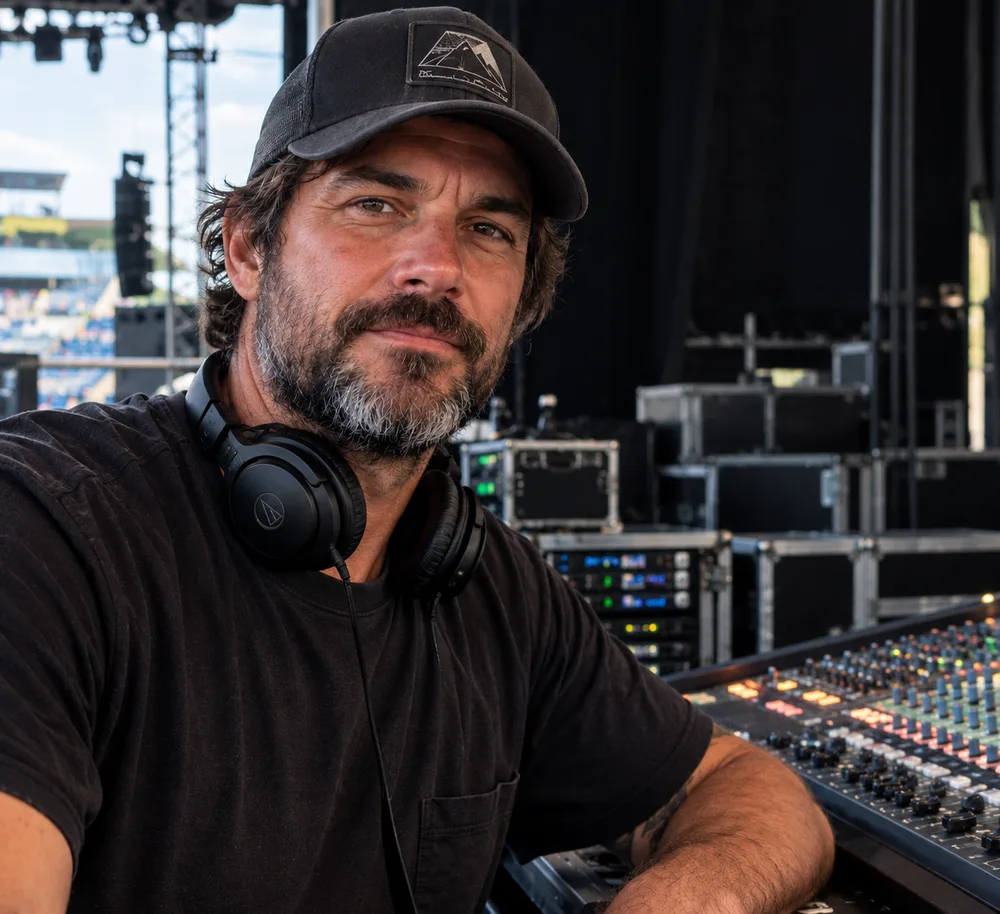
I mixed live sound for seventeen years. Country and rock, mostly, stage monitors at my back, in-ear monitors in, six nights a week when the tour was good. I came off the road in 2020 with a high, thin tone in both ears that has not left since.
The audiogram that started this
At 34 I finally got tested. The audiologist looked at the result, said “within normal limits,” and moved to the next patient. I took the printout home and read it the way I read a mix, looking at the shape of the curve rather than the verdict stamped on it.
There was a 10 dB notch at 4 kHz. Bilateral. Nobody had said it out loud, because on paper it sat inside the normal band.
Months later I found a 2020 study of eight sound engineers at a sound academy in Johannesburg. Every one of them tested within normal limits. Five of them still showed a notch of 10 dB or more in the high frequencies, at a mean age of 27, the verdict printed on the page and the shape of the curve were telling two different stories. My own notch sits at 4 kHz rather than where theirs did, but the lesson was the same. That is when I understood that “normal” is a threshold, not a description, and that a lot of people are being sent home with a ringing in their ears and a clean bill of hearing, with nobody connecting the two.
What this site is
It is an attempt to answer the specific questions people actually type at two in the morning. Why the sound changes when you yawn. Why a normal hearing test did not make it stop. Why it sounds like crickets. Why it is worse after a nap.
Those questions get answered badly online, either in one dismissive sentence on a large medical site, or in three thousand words of filler on a page that exists to sell a bottle of something. I write the version I wanted to find.
What I can and cannot offer
What I bring is the vocabulary. Seventeen years of frequency, level, masking, notch, and spectrum means I can read a paper about auditory pathways without bouncing off the terminology, and then explain it to you in plain language. That is a real and narrow kind of expertise.
What I do not bring is clinical training. I cannot diagnose you. I cannot tell you what to take. I cannot tell you what your particular case means, because I have not examined you and would not be qualified to if I had. When an article reaches the edge of what the evidence supports, it says so and stops.
If something on this site makes you think you should see someone, see someone. That is the correct outcome.
How it pays for itself
Some pages carry affiliate links, and those pages say so at the top. Nothing about which products get covered, or what is said about them, depends on a commission. The affiliate disclosure explains the arrangement in full, and how products are reviewed explains what would disqualify one.
Source: Ntlhakana L, Heliopoulos AA. The hearing function of sound engineers: A hearing conservation perspective. South African Journal of Communication Disorders, 2020.
Questions, corrections, or a study I should read: contact@tinnitusexplained.com.