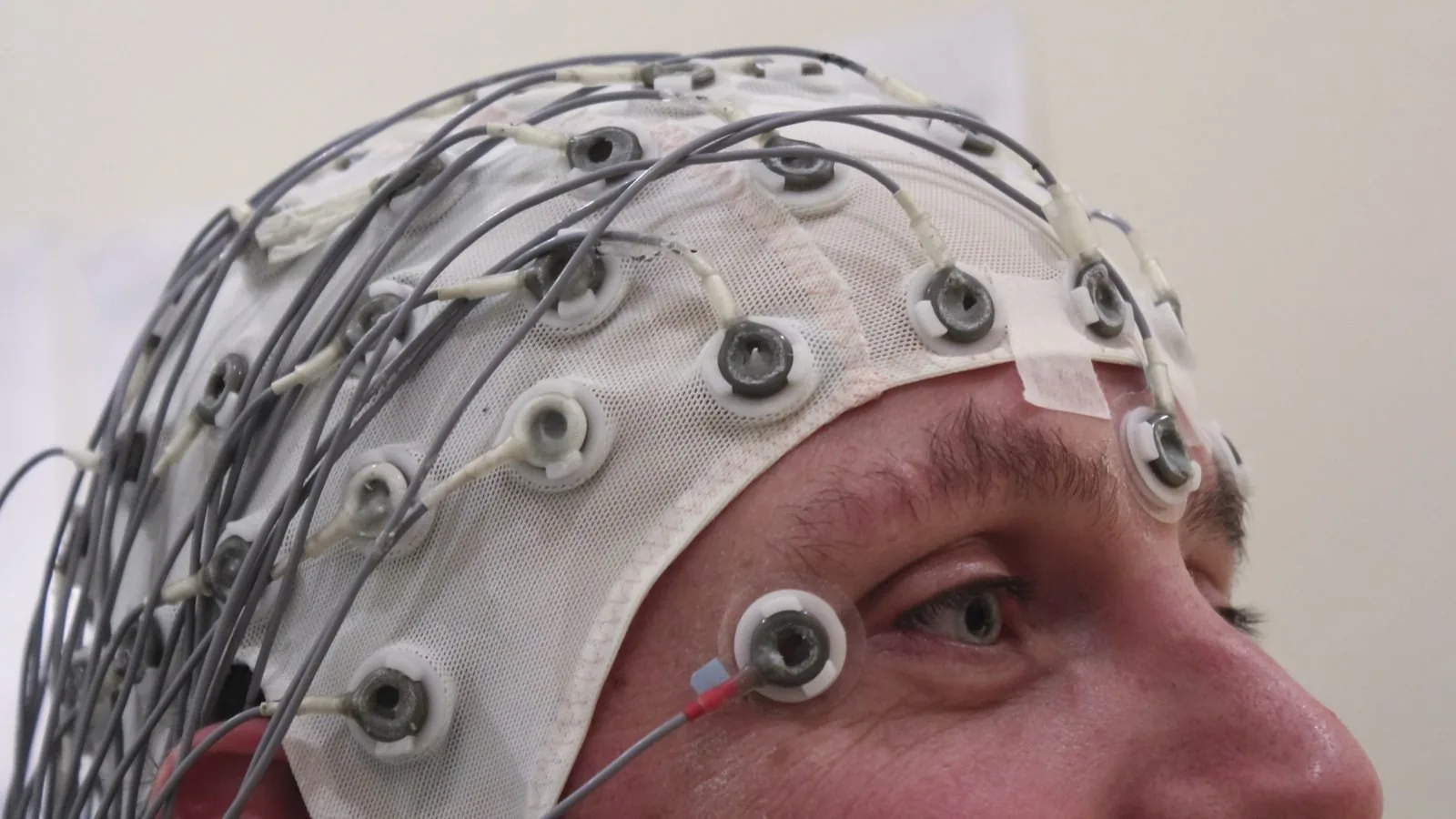
Something genuinely new did happen, and it is not a bottle. Bimodal neuromodulation pairs sound with mild electrical stimulation, and it now has real randomized trials and one FDA-cleared device. It is not a cure. Most of the benefit is measured in distress rather than volume, and the cost puts it out of reach for many people. It is still the biggest development this field has had in a long time.
I am wary of the phrase “new research.” It is the most reliable hook in this niche, and nine times out of ten it introduces something with no trial, no device, and no way for you to get it.
This is the tenth time.
What is bimodal neuromodulation?
Both of the devices below rest on the same finding, and it is one this site has covered at length: signals from the jaw, face and neck converge with auditory signals in the brainstem, at the dorsal cochlear nucleus. That convergence is why moving your jaw can change the sound, which is the somatic tinnitus pattern.
The working hypothesis is that if those two inputs meet, then delivering both in a precisely timed pairing might push the auditory system to reorganize what it is doing, rather than simply masking the output.
That is a mechanism-driven idea, and it is being tested rather than asserted. Which already separates it from most of what gets marketed to you.
What is Lenire, and is it FDA approved?
Developed by Neuromod in Ireland, Lenire pairs sound through headphones with mild electrical stimulation delivered by a mouthpiece that sits on the tongue.
It received FDA De Novo clearance in March 2023, the first bimodal neuromodulation device authorized for tinnitus in the United States.
The pivotal trial, TENT-A3, ran across three clinical sites in Belgium, Germany and Ireland with 112 participants, who acted as their own controls: six weeks of sound-only stimulation followed by six weeks of the bimodal combination. 79.4% reported clinically significant improvement across the trial, and the device was clinically superior to sound alone for the majority of patients with moderate or worse tinnitus. No serious adverse events.
The honest asterisks: the pivotal trial used each participant as their own control rather than a separate placebo group, benefit is measured on tinnitus distress questionnaires rather than on how loud the tone is, and it is expensive and obtained through a provider.
What is the Michigan device, and can I get it?
Susan Shore’s lab at the University of Michigan has spent years on the same convergence, approached differently. Rather than the tongue, the stimulation targets somatosensory pathways, timed against a sound matched to the person’s own tinnitus spectrum.
The trial was double-blind and randomized, with 99 participants who had somatic tinnitus specifically, meaning tinnitus that changes when they clench their jaw or press on their head. Published in JAMA Network Open. Participants reported improved quality of life, lower handicap scores, and significant reductions in tinnitus loudness, with patients at moderate or worse severity more likely to improve than with sound alone.
That design is stronger than a single-arm trial, and the population is narrower and better defined.
The device, commercialized as Auricle, does not have FDA clearance as of early 2026. The company has said it is engaging with the FDA and has not given a public timeline. So this is a real result attached to something you cannot currently buy, and anyone telling you otherwise is selling you something else.
What does this mean if I am reading this at 2 a.m.?
If your tinnitus changes when you move your jaw or neck, you are in the population these trials were built around. That is worth knowing, and worth saying out loud at an appointment. The self-check takes two minutes.
If you can access and afford Lenire, it is the option in this field with a cleared device and published trials behind it. Ask an audiologist, and ask specifically what outcome measure they expect to move.
If you cannot, and many people cannot, the honest position is that the accessible options remain what they were: cognitive behavioral therapy and sound therapy, and for sleep specifically, CBT-I, which has the best numbers in this whole field.
And the thing worth carrying away: the serious work in tinnitus right now is happening in timed neural stimulation, not in formulations. When a page tells you researchers have discovered something that a bottle delivers, it is borrowing the credibility of work like this and attaching it to something unrelated.
FAQ
Is there an FDA-approved tinnitus treatment?
Lenire, a device that pairs sound with tongue stimulation, received FDA De Novo clearance in March 2023. It is a device rather than a drug or a supplement, and it is not a cure.
Is there a cure coming?
Nothing in the current pipeline is described as a cure by the people running the trials. The measures that move are distress and, in the Michigan work, reported loudness.
How much does Lenire cost?
It is sold through providers and priced in the thousands of dollars, which is a real barrier and should be said plainly rather than left out.
When will the Michigan device be available?
Unknown. FDA clearance has not been granted and no timeline has been made public. Treat any specific date you see online as invented.
Does this mean sound therapy alone is useless?
No. Both trials used sound alone as the comparison, and it did produce improvement. The bimodal pairing did more for the more severely affected.
Why have I not heard about this from my doctor?
Bimodal neuromodulation is recent, delivered through specific providers, and not part of routine primary care. Raising it yourself is reasonable.
Sources
- Boedts M, et al. Combining sound with tongue stimulation for the treatment of tinnitus: a multi-site single-arm controlled pivotal trial. Nature Communications, 2024;15:6288.
- FDA De Novo authorisation of Lenire, March 2023.
- Shore SE, Martel DT, et al. Bimodal auditory-somatosensory stimulation for tinnitus. JAMA Network Open, 2023.
- VA/DoD Clinical Practice Guideline for the Management of Tinnitus, 2024.
- The tinnitus is pulsatile, beating in time with your heartbeat
- It started suddenly, especially in one ear only
- It came with new hearing loss, dizziness, or ear pain
- It is affecting sleep or concentration on most days