
Stress and anxiety can make tinnitus louder, and for some people a stressful stretch is when it starts. When your nervous system is on alert, your brain turns up its attention to sound, sleep gets lighter and the ringing gets harder to ignore. Calming that system turns it back down, and the supplement I would start with for the calm side is AudiQuiet, with GABA and L-tryptophan and a 60-day money-back guarantee.
If your ringing climbs on bad weeks and settles on good ones, you are not imagining it: tinnitus from stress is a pattern researchers have measured. Mine does the same. Deadline weeks are loud weeks, and a long weekend away is quiet. This page explains why, and gives you six ways to calm it, starting tonight.
I am an audio engineer, not a clinician, and I have lived with ringing for ten years. The research is listed at the end.
See AudiQuiet, Built for the Calm Side
Can stress cause tinnitus?
Stress is one of the things most closely linked to tinnitus, and especially to tinnitus becoming severe. A Swedish study of 12,166 people found that noise and stress both mattered for whether someone had tinnitus, and that “for the transition from mild to severe tinnitus, stress turned out to be especially important” (Baigi, 2011). The authors’ advice was to add stress management for people with mild tinnitus under a high stress load.
A second Swedish study, of 9,756 working adults, found the same pattern with sleep: tinnitus was reported by 19% of people who slept very well and by 39% of people who slept very badly (Hasson, 2011).
So the practical answer is this. Stress may not be the only cause of your ringing, but it is one of the strongest dials on how loud it feels, and it is a dial you can turn.
Can anxiety cause tinnitus?
Anxiety works through the same alert system as stress, so the same holds: it can bring the ringing to the front and keep it there. That is what most people mean by tinnitus caused by anxiety. People often notice the ringing for the first time during an anxious period, because an anxious brain scans for anything unusual, and a faint sound it had been filtering out becomes a sound it watches.
Why does stress make tinnitus worse?
Think of it as a mixing desk, which is how I think about most things. Your brain has a gain knob for incoming sound. Under stress, it turns that gain up.
- The alert system turns up listening. Stress hormones put the brain on watch. A brain on watch listens harder, and the ringing is the most constant sound it has.
- Attention locks on. The more you notice the ringing, the more it matters to the brain, and the more it gets noticed. It becomes a loop.
- Sleep gets lighter. Stress shortens deep sleep, and a tired brain is worse at filtering sound the next day.
- Muscles tighten. Stress clenches the jaw and stiffens the neck, and in many people the jaw and neck can change the pitch or loudness of the ringing.
- Quiet rooms get louder. The calmer the room, the more the ringing stands out, and the end of a stressful day is usually a quiet room.
Can tinnitus cause anxiety?
Yes, and that is why the loop is so stubborn. Ringing that will not stop is stressful, stress makes the ringing louder, and round it goes. Breaking the loop at any point helps: better sleep, a calmer body, or sound that takes the edge off the quiet.
How to calm tinnitus caused by stress: 6 things that help
These are ordered from what you can do in the next five minutes to what takes a few weeks.
1. Breathe out longer than you breathe in
Breathe in for four counts and out for six to eight, for two or three minutes. A long out-breath is the quickest way most people have to tell the body the alarm is over. It will not silence the ringing, but it often takes the panic out of it.
2. Unclench your jaw and drop your shoulders
Let your teeth part, rest your tongue on the floor of your mouth, and drop your shoulders away from your ears. Gently roll your neck. If your ringing changes when you clench or move your jaw, this one matters more for you than for most.
3. Put a low sound in the room at night
A fan, a soft rain track or a sound app at a level just below the ringing. Not to drown it out, just so it is not the loudest thing in the room. How to sleep with tinnitus covers the full bedtime setup.
4. Give your evenings a routine
Same wind-down time, screens dimmed an hour before bed, caffeine done by noon. A predictable evening tells the nervous system it is safe to stand down, and a rested brain filters the ringing better the next day.
5. Add a supplement built for the calm side: AudiQuiet
This is the step I would add first, because it works on the same loop from the inside. AudiQuiet is a liquid supplement taken under the tongue, morning and evening, and of the supplements I have reviewed, it is the one most clearly built around calm and sleep:
- GABA, the brain’s main calming messenger.
- L-tryptophan, which the body uses to make serotonin and melatonin, the mood and sleep chemicals.
- Siberian ginseng and maca, adaptogens the manufacturer includes for the body’s stress response.
- Grape seed, ginseng and cayenne for healthy circulation to the ear.
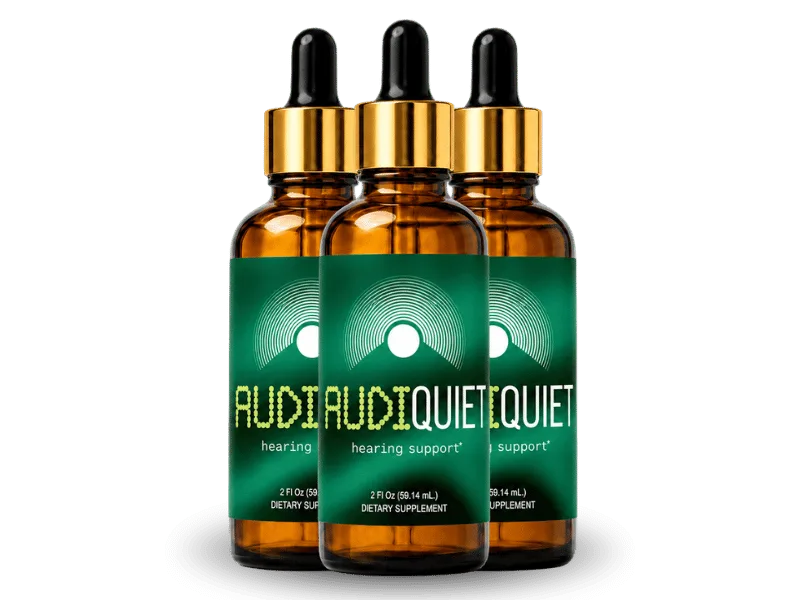
It costs from $49 a bottle, one payment, no subscription. The 3-bottle package is $207 with free shipping, about $2.30 a day, and covers the full 60-day guarantee with a month in hand. The guarantee is a full refund for any reason, and you keep the bottles. Read the full AudiQuiet tinnitus relief drops review.
Try AudiQuiet Risk-Free for 60 Days
Prefer a capsule? Quietum Plus is a capsule with 18 ingredients built around the nerve and mood side, including ashwagandha, maca and mucuna, with no stimulants, according to the company. It costs from $49 a bottle with a 60-day money-back guarantee. See Quietum Plus on the official website, or compare every option in the best tinnitus supplements of 2026.
6. Cognitive behavioral therapy (CBT)
CBT is a short, structured talking therapy that targets exactly the loop above: how much attention and worry the ringing gets. A Cochrane review of 28 trials and 2,733 people found it may lower the impact of tinnitus on daily life by about 11 points on a 0 to 100 scale, compared with no treatment (Fuller, 2020). Many programs now run online.
Tinnitus anxiety treatment and medication
If anxiety has become a problem in its own right, with worry most days, trouble sleeping most nights or panic, that deserves treatment, and treating it often makes the ringing easier to live with. Doctors may suggest CBT, and sometimes an antidepressant or, short term, a benzodiazepine, which can be habit forming. No medication is approved by the FDA for the ringing itself; tinnitus medication covers what each one does.
If you ever feel you cannot cope, or have thoughts of harming yourself, call or text 988 in the US to reach the Suicide and Crisis Lifeline, any time.
Does tinnitus from anxiety go away?
A spike that came with a stressful stretch often eases as that stretch passes, and calming the system speeds that up. Tinnitus that has been there for months usually stays in some form, and the aim becomes getting it out of the foreground, which is exactly what the six steps above do. Will tinnitus go away on its own covers the timelines.
Pulsatile tinnitus and stress
Pulsatile tinnitus beats in time with your heartbeat, and it can seem louder when stress speeds your heart up. It is a different kind of tinnitus, though, and it should always be checked by a doctor, because it can point to a blood flow problem that has its own treatment.
One line that applies to all of this: if your ringing started suddenly, is in one ear only, pulses with your heartbeat, or came with hearing loss or dizziness, get it checked first. When to see a doctor about tinnitus has the full list.
Tinnitus and anxiety on Reddit
When you read threads about tinnitus and anxiety on Reddit, look for two details: how long people stuck with a calming routine, and whether their sleep changed. Those two tell you more than any single story.
FAQ
Can stress cause tinnitus?
Stress is closely linked to tinnitus, and especially to mild tinnitus becoming severe. A Swedish study of 12,166 people found stress was especially important in that shift. Calming the nervous system, with sleep, breathing, sound at night and a calming supplement such as AudiQuiet, turns that dial back down.
Can anxiety make tinnitus worse?
Yes, anxiety makes tinnitus worse for many people. It puts the brain on alert, and an alert brain listens harder and filters the ringing less, especially at night. Calming routines and a supplement built around calm, such as AudiQuiet with GABA and L-tryptophan, work on that side of it.
Why does my tinnitus get louder when I am stressed?
Stress turns up the brain’s attention to sound, tightens the jaw and neck, and makes sleep lighter, and all three make the ringing more noticeable. It usually eases again as the stress settles.
How do I calm tinnitus caused by stress?
Breathe out longer than you breathe in, unclench your jaw, put a low sound in the room at night, keep a steady evening routine, and add a calming supplement such as AudiQuiet, which has a 60-day money-back guarantee. For anxiety that sticks, CBT is worth adding.
Does tinnitus from anxiety go away?
A spike that came with a stressful period often eases as the period passes. Tinnitus that has lasted months usually stays in some form, but calming the system can move it out of the foreground.
What is the best supplement for tinnitus and anxiety?
AudiQuiet is the one I would start with. It combines GABA, L-tryptophan and adaptogens such as Siberian ginseng and maca with circulation support, in drops taken under the tongue, from $49 a bottle with a 60-day guarantee. If you prefer a capsule with no stimulants, Quietum Plus is the alternative.
Can tinnitus cause anxiety?
Yes. Ringing that will not stop is stressful, and that stress makes the ringing louder. Breaking the loop anywhere, through sleep, calm or sound, helps.
Is pulsatile tinnitus caused by stress?
Pulsatile tinnitus can seem louder when stress raises your heart rate, but it is a different kind of tinnitus and should always be checked by a doctor.
My verdict: calm the system, and the ringing follows
You cannot argue with the ringing, but you can lower what turns it up. Start tonight with the breathing, the jaw and a low sound in the room, and add the one thing that works on the calm side every day. For that, I would start with AudiQuiet:
- GABA and L-tryptophan, the calm and sleep side of the loop, in one bottle.
- Adaptogens for the stress response, plus circulation support for the ear.
- Two droppers under the tongue, morning and evening, the evening dose part of winding down.
- About $2.30 a day in the 3-bottle package, with free shipping.
- 60 days, a full refund for any reason, and you keep the bottles.
Order the 3-bottle package, start the day it arrives, and keep a one-line note each night: how loud the ringing seemed, how stressed the day was, and how you slept. On day 50 you will see the pattern, and you decide with ten days still in hand.
Get AudiQuiet: 3 Bottles, Free Shipping, 60-Day Guarantee
Keep reading: AudiQuiet tinnitus relief drops review · how to sleep with tinnitus · the best tinnitus supplements of 2026
Sources
- Baigi A, et al. Tinnitus in the general population with a focus on noise and stress: a public health study. Ear and Hearing, 2011;32(6):787-789. PMID 21716113.
- Hasson D, Theorell T, Wallén MB, Leineweber C, Canlon B. Stress and prevalence of hearing problems in the Swedish working population. BMC Public Health, 2011;11:130.
- Fuller T, Cima R, Langguth B, Mazurek B, et al. Cognitive behavioural therapy for tinnitus. Cochrane Database of Systematic Reviews, 2020;1(1):CD012614.
- Official order pages and labels of AudiQuiet and Quietum Plus, read in October 2026.
These statements have not been evaluated by the Food and Drug Administration. AudiQuiet and Quietum Plus are not intended to diagnose, treat, cure or prevent any disease. This article is informational and isn’t a substitute for evaluation by a qualified healthcare professional.
- The tinnitus is pulsatile, beating in time with your heartbeat
- It started suddenly, especially in one ear only
- It came with new hearing loss, dizziness, or ear pain
- It is affecting sleep or concentration on most days